We Simulated 8,000 Sessions of Every Roulette Betting System. Here Is What Broke.
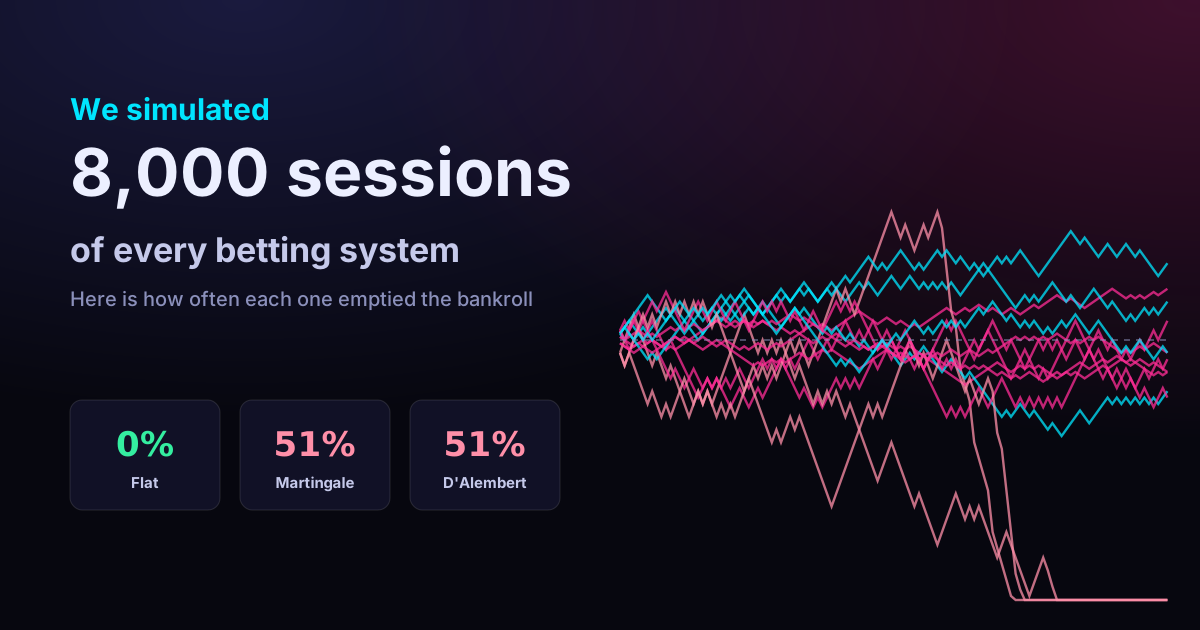
Every roulette betting system promises something — steady small wins, protection from a bad run, a way to "manage" the house edge. Instead of arguing about the promises, we ran each system through 8,000 simulated sessions on a European wheel and wrote down what happened to the bankroll.
The setup
Every number in this article comes from the strategy simulator on this site, and you can reproduce any of it by entering the same settings. The baseline run used:
- Wheel: European, single zero — 18 winning pockets in 37 for every even-money bet.
- Bankroll: $1,000. Base unit: $10. Table maximum: $1,000.
- Session length: 200 spins, or until the bankroll could no longer cover the base unit.
- Bets: even money (red) throughout, so every system plays the same game and only the staking changes.
- Sessions: 8,000 per system, drawn from the browser's cryptographic random number generator.
Seven systems ran under identical conditions: flat betting, Martingale, Grand Martingale, D'Alembert, Fibonacci, Labouchère (starting sequence of six units) and Paroli (three-win cap). If you are not sure how a system works, the strategies guide describes each one.
The results
| System | Bankroll wiped out | Average turnover | Average loss | Loss ÷ turnover |
|---|---|---|---|---|
| Flat betting | 0.0% | $2,000 | $54 | 2.7% |
| Paroli | 0.0% | $3,382 | $91 | 2.7% |
| Fibonacci | 32.3% | $4,342 | $124 | 2.9% |
| D'Alembert | 50.6% | $9,213 | $254 | 2.8% |
| Martingale | 51.0% | $5,147 | $142 | 2.8% |
| Labouchère | 57.5% | $8,230 | $233 | 2.8% |
| Grand Martingale | 65.6% | $6,429 | $155 | 2.4% |
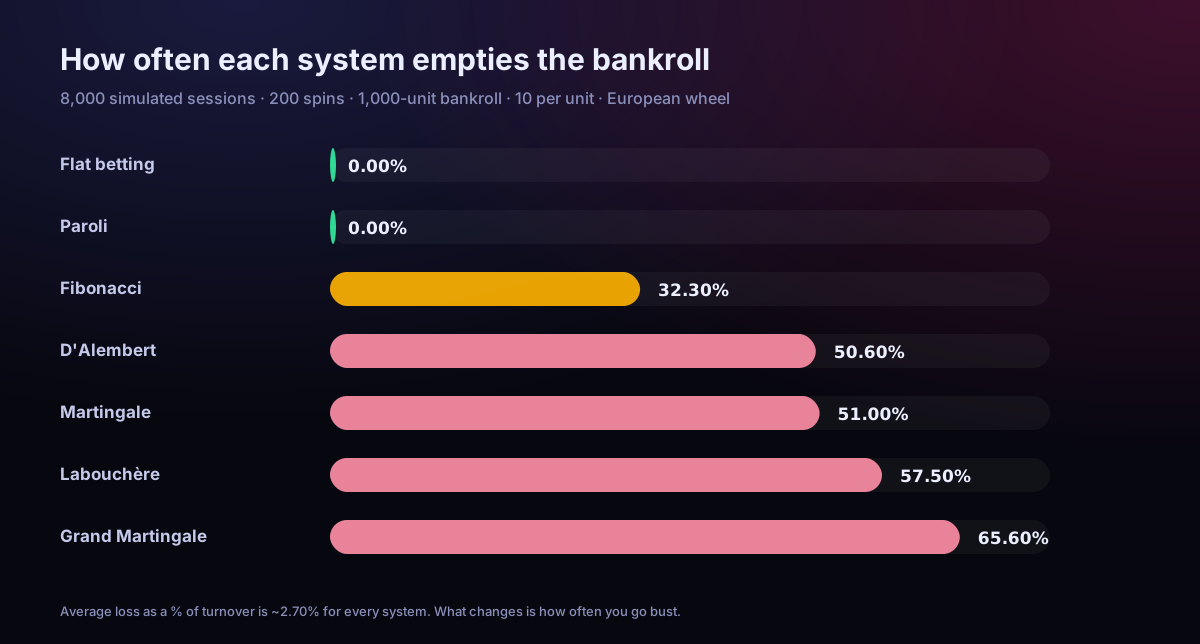
Loss ÷ turnover sits around the 2.70% house edge for every system; small deviations are simulation noise and the effect of sessions that end early on ruin. Rerun it in the simulator and your figures will land within a point or two of these.
Read the last column first. Whatever the system did with stake sizes, it lost roughly 2.70% of what it staked — the European house edge, give or take sampling noise. No system changed the price of the game. That is not a surprise to anyone who has worked through the maths in our house edge guide, but it is reassuring to see the arithmetic confirmed by 56,000 sessions of brute force.
Then read the first column. The systems did not change the price — but they changed, enormously, how often you leave with nothing. Flat betting at $10 a spin from a $1,000 bankroll essentially never busts in 200 spins. Martingale does it half the time. Grand Martingale two times in three.
The column nobody reads: turnover
Most write-ups of betting systems report the ruin rate and stop there. The more revealing number is average turnover — how much money each system actually put on the table over the session.
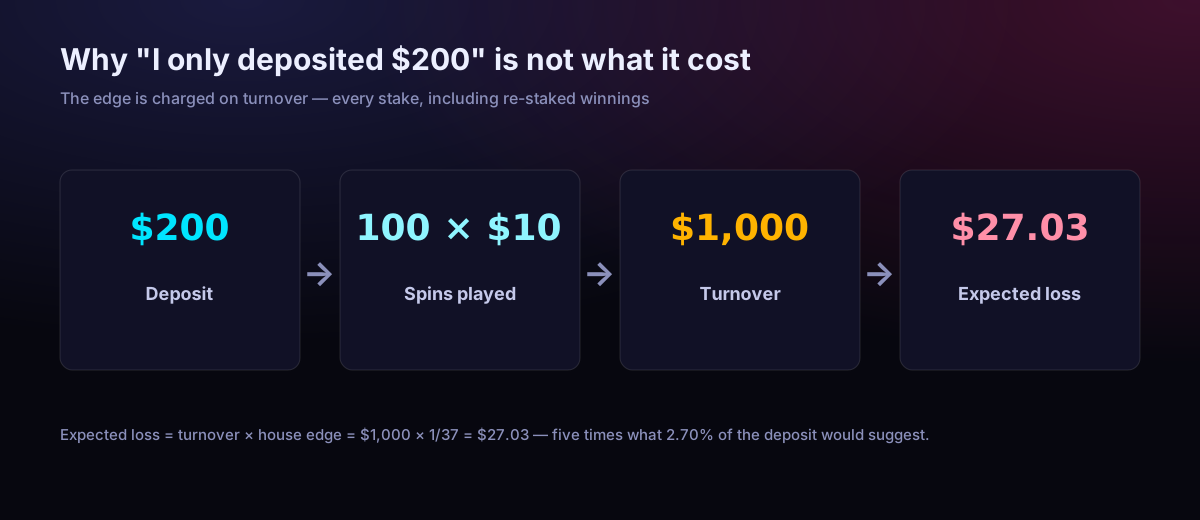
Flat betting staked $2,000 over 200 spins, exactly as you would expect. Martingale staked $5,147. D'Alembert staked $9,213 — four and a half times as much as flat betting for the same number of spins. Because the house edge is charged on every dollar staked, turnover is what decides how much a system costs you in absolute terms. D'Alembert lost an average of $254 per session; flat betting lost $54. Same edge, same game, nearly five times the bill.
This is the key insight that the system sellers leave out. Progression systems do not just reshape the outcome distribution. They also multiply how much you stake, and the edge applies to all of it. Our session cost calculator works the same way: multiply turnover by the edge, and that is what the evening costs.
The D'Alembert surprise
D'Alembert — add one unit after a loss, subtract one after a win — is almost universally recommended as the "safe" alternative to Martingale. Its escalation is linear rather than exponential, so it never produces the terrifying $1,280 bet that Martingale reaches after seven losses.
In our runs it busted the bankroll just as often as Martingale (50.6% against 51.0%) and lost 1.8 times as much money on average. We checked this against six different combinations of bankroll, unit size and table limit, and the ordering never flipped.
The reason is in how the two systems recover. Martingale resets to the base unit after every win, so after a mixed run it is usually back to betting $10. D'Alembert only steps down one unit per win, so in a choppy sequence — which is what roulette mostly produces — the stake ratchets upward and stays there. It feels gentler bet to bet, because there is never one enormous wager. But it spends most of the session betting well above the base unit, which drives up turnover and, with it, the bill.
Gentler per bet is not the same as safer. If you remember one thing from this article, it should be that a system's danger is measured by what it ends up staking, not by how frightening its biggest bet looks.
What happens over longer sessions
200 spins is roughly four hours at a live table. We reran the whole field at 500 spins to see how the picture changes with more time at the wheel:
| System | Ruin at 200 spins | Ruin at 500 spins |
|---|---|---|
| Flat betting | 0.0% | 0.1% |
| Paroli | 0.0% | 5.8% |
| Fibonacci | 32.3% | 56.9% |
| Martingale | 51.0% | 73.4% |
| D'Alembert | 50.6% | 80.5% |
| Labouchère | 57.5% | 80.8% |
| Grand Martingale | 65.6% | 83.4% |
Every progression system gets dramatically worse with time. This is the crucial difference between a negative-expectation game and an investment: in a game with a house edge, the longer you play, the more certain the losing outcome becomes. A short session is dominated by luck; a long one by arithmetic. The bankroll calculator shows the same effect from a different angle.
Table limits: the wall Martingale always hits
Martingale's theory is that a win will eventually come and recover every previous loss. In a world with no table maximum and an infinite bankroll, that is true. In ours, both run out.
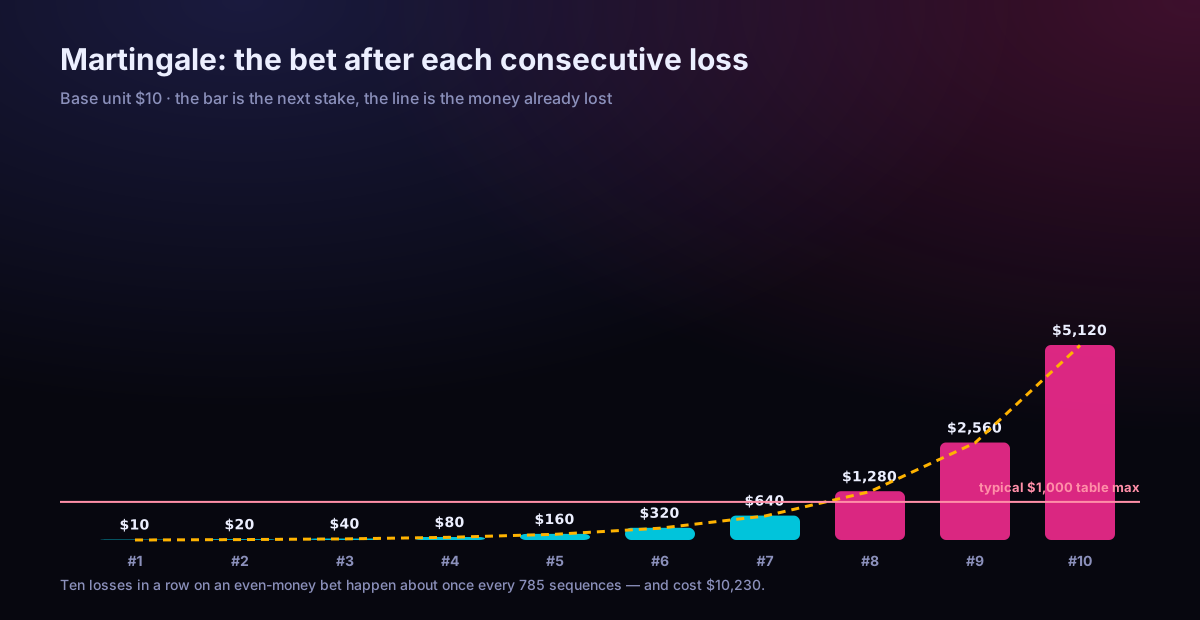
Starting at $10, the eighth consecutive loss calls for a $1,280 bet. A $1,000 table maximum ends the progression there, whatever is left in your account. Ten losses in a row — which on an even-money bet happens about once every 785 sequences — costs $10,230 in total. Play two hundred spins a night and you will meet one of those sequences sooner than intuition suggests.
Interestingly, a lower table maximum actually reduced Martingale's ruin rate in our runs (47% at a $500 cap against 51% at $1,000), because the cap stops the system before it can bet the whole bankroll on a single spin. It also guarantees that a long losing run is locked in as a loss rather than recovered — which is exactly what the house wants.
Takeaways
- No system changes the house edge. Every one lost about 2.70% of turnover — the price of the European wheel.
- Systems change the ruin rate, a lot. From essentially zero for flat betting to two in three for Grand Martingale over 200 spins.
- Turnover drives the bill. Progression systems stake two to five times more than flat betting over the same spins, and pay the edge on all of it.
- "Safe" D'Alembert is not safe. It busts as often as Martingale and costs more.
- Time is not your friend. Longer sessions push every progression system toward ruin.
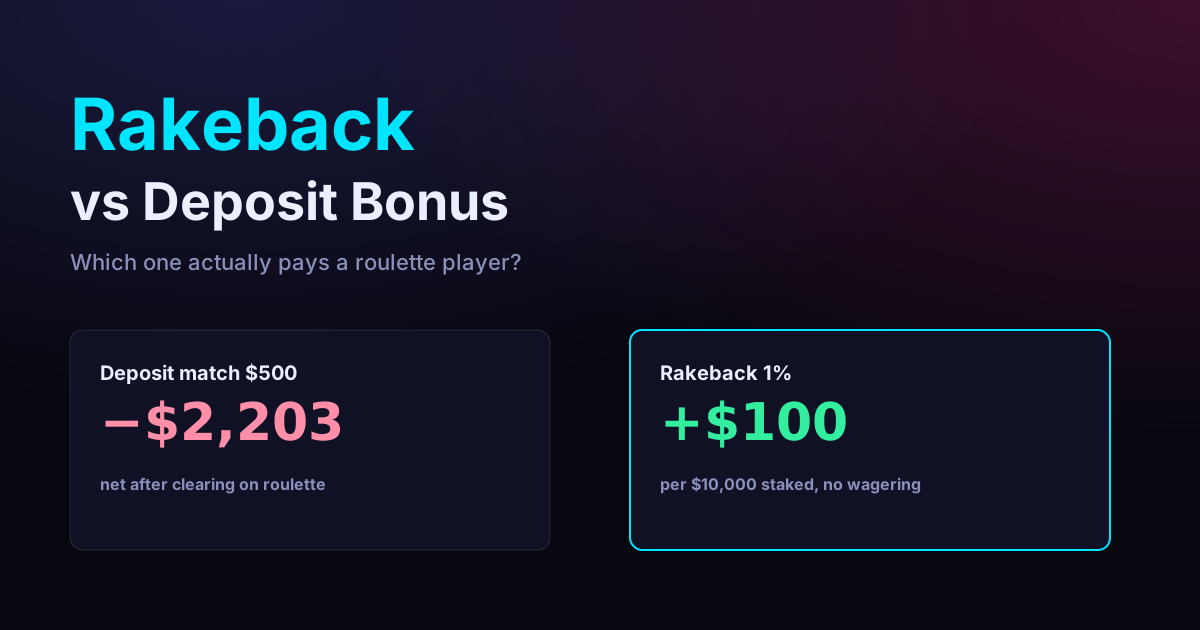
- The real levers are elsewhere: play a French table (1.35% on even money), play slower, and claim rakeback rather than chasing a system.
If you still want to try a system, try it on the free European demo first, with the bankroll and table limit you would actually use. The simulator will tell you the odds of the session ending badly; the demo will tell you what it feels like when it does.
Frequently Asked Questions
Which roulette betting system is the best?
None improves the odds — every system in our simulation lost about 2.70% of what it staked on a European wheel. If "best" means least likely to empty your bankroll, flat betting wins by a distance; Paroli is a close second because its losses are capped at one unit per cycle.
Is Martingale a winning strategy?
It wins small amounts most of the time and loses catastrophically occasionally. In our 200-spin runs it emptied a $1,000 bankroll in 51% of sessions, and lost an average of $142 per session — about 2.8% of what it staked.
Why does D'Alembert lose more than Martingale?
Because it stakes more. D'Alembert only reduces the bet by one unit after a win, so in choppy sequences the stake drifts upward and stays there. It averaged $9,213 of turnover per session against Martingale's $5,147, and the house edge is charged on every dollar.
Can I reproduce these numbers?
Yes. Open the strategy simulator, set a $1,000 bankroll, $10 unit, $1,000 table maximum, 200 spins and the European wheel, then compare all seven systems. With 8,000 sessions your ruin rates will land within a point or two of ours.
More from the blog

18+. Roulette has a fixed house edge, so over enough spins the maths favours the operator — always. If you play for real, treat it as money spent on entertainment, set a limit before you start and stop when you reach it. Our responsible gambling page covers the warning signs and where to get free, confidential help.