Plinko — Free Demo
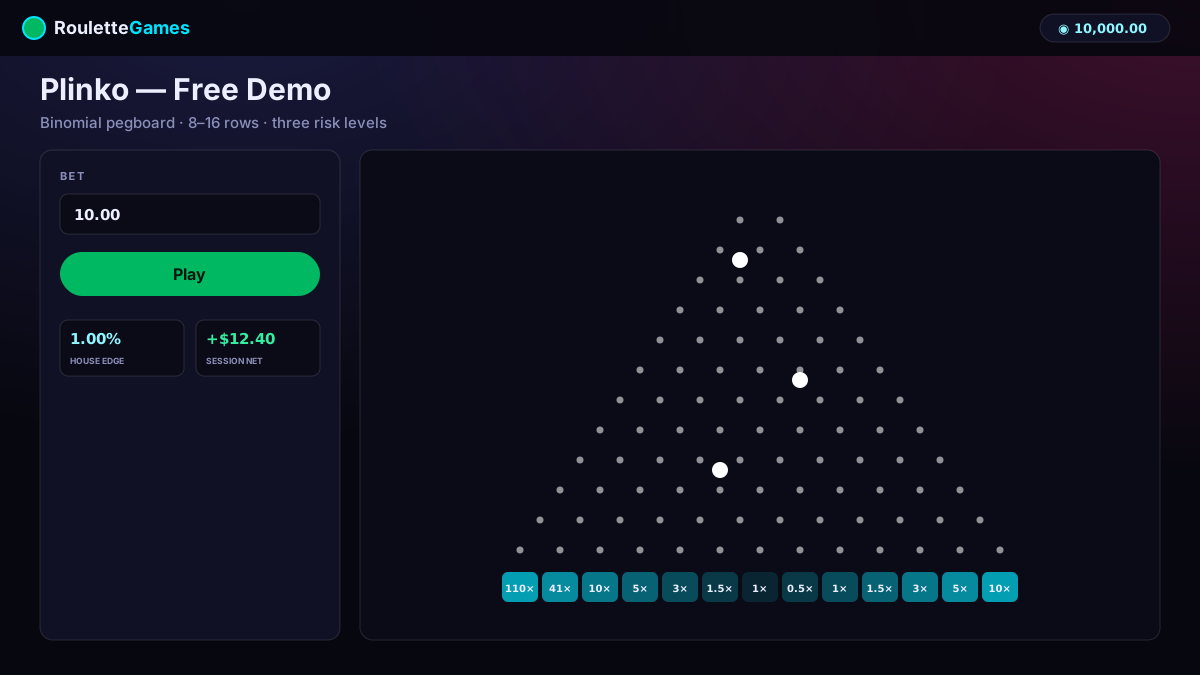
Plinko drops a ball through rows of pegs into a row of multiplier buckets. It is a binomial distribution you can watch: the middle buckets catch most balls, the edges almost none. This free demo lets you change rows and risk and shows the edge of every paytable.

GETRAKEBACK. 18+.
A binomial distribution you can watch
A ball drops through rows of pegs, bouncing left or right at each one, and lands in a bucket. With 16 rows there are 17 buckets, and the chance of each is a coin-flip count: the middle bucket collects about 20% of balls, the outer ones about one in 65,000.
Multipliers mirror that. Buckets you almost never reach pay hundreds or thousands of times your stake; the middle pays less than your stake back. Every paytable here is generated so the probability-weighted average returns 99% of turnover, then rounded to a displayable number of decimals — which moves the real figure by up to about a third of a percentage point either way. The panel shows the edge it computes from the rounded table rather than the target, so the number on screen is the number you are actually playing.
Drop ten balls and the shape appears immediately. Drop a hundred and you will understand why "high risk" mostly means "watch the ball land in the middle again".
Frequently Asked Questions
What is the house edge on Plinko?
Close to 1% at every risk level and row count in this demo. The paytables are generated from the binomial probabilities to return 99% of turnover, and rounding the multipliers to a readable precision shifts the true figure by up to about 0.3 of a percentage point. The panel displays the edge computed from the actual rounded table.
Do more rows improve the odds?
No. More rows widen the distribution, so the extreme buckets pay far more and are hit far less often. The expected cost per drop is unchanged.
How to play the Plinko demo
- Set a bet, a risk level and the number of rows (8–16).
- Drop one ball or ten. Each bounces left or right at every peg and settles in a bucket.
- The bucket's multiplier is your payout. The panel shows the computed edge of the current table.
Getting the most out of the Plinko demo
Drop a hundred balls
The shape of the binomial distribution appears within seconds. The rare edge buckets are rare for a reason.
More rows, wider spread
Sixteen rows push the extremes further out — bigger top multipliers, hit far less often. The cost stays near 1%.
Common mistakes
- Chasing the 1,000× bucket. On 16 rows it is reached about once in 65,000 drops.
Demo vs real money
This demo uses the same paytable and probabilities as a real table, so everything you learn about the game transfers directly. What does not transfer is the result: each round is independent, so a winning demo session says nothing about a real one. Treat it as a flight simulator, not a rehearsal of luck — and if you do move to real money, set a limit before you start.
Not sure where to begin? The 30-minute practice plan uses this demo alongside the calculators.
More free games
18+. Roulette has a fixed house edge, so over enough spins the maths favours the operator — always. If you play for real, treat it as money spent on entertainment, set a limit before you start and stop when you reach it. Our responsible gambling page covers the warning signs and where to get free, confidential help.