Roulette Rules
Key takeaways
- A round is simple: place bets, the ball lands in one of 37 (or 38) pockets, winners are paid.
- Every bet is a set of pockets priced at
36 ÷ numbers covered − 1— which is why every bet costs the same 2.70% on a single-zero wheel. - Four rules change the maths: la partage, en prison, surrender and the table maximum.
- The one bet to avoid outright is the American five-number bet at 7.89%.
Roulette has fewer rules than almost any casino game, and most confusion comes from bet names rather than mechanics. This page covers a full round, every bet on the felt, and the four rules that actually change what the game costs.
How a round works
The dealer opens betting, players place chips on the layout, the wheel spins, the ball is released, and at some point the dealer calls "no more bets". The ball settles into one numbered pocket. The dealer marks it, clears the losing chips, pays the winners, and betting reopens.
That is the whole game. There are no decisions after the bet is placed, no cards, no dealer strategy and nothing to learn about play. Every choice you make happens before the ball is released, which is why roulette is the best game for understanding what a casino bet actually is: a claim on a set of pockets, priced slightly below its true value.
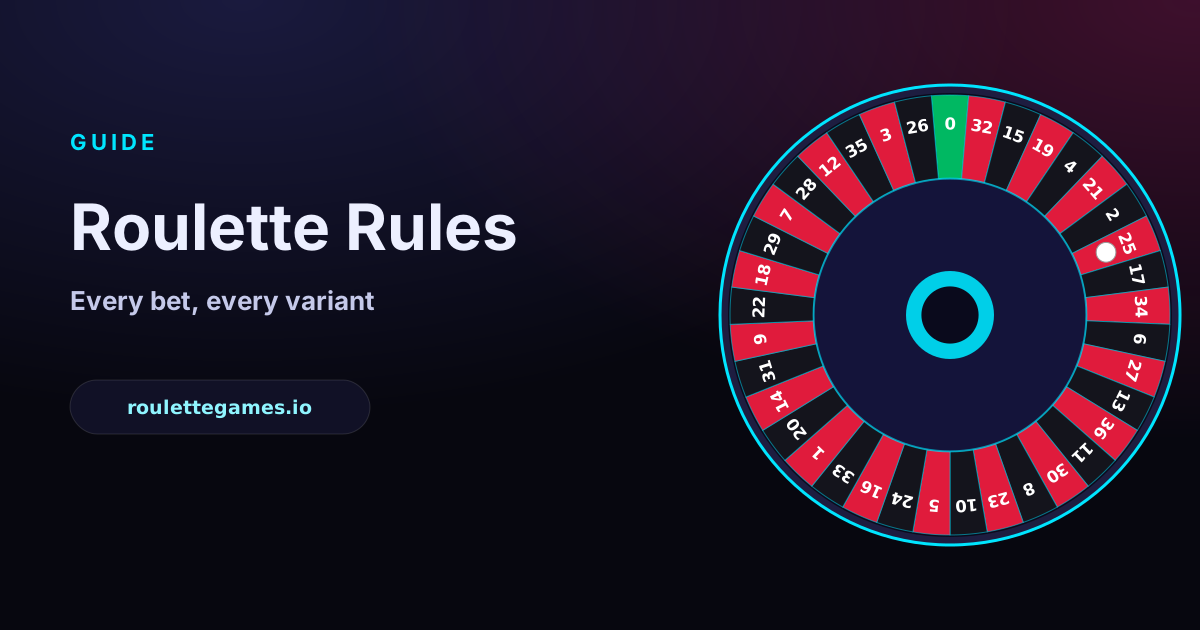
On the wheel, numbers 1 to 36 alternate red and black. Zero is green. American wheels add a second green pocket, 00. The layout on the felt is arranged in three rows of twelve, which is why the vertical neighbours of a number differ by one and the horizontal neighbours by three.
Inside bets
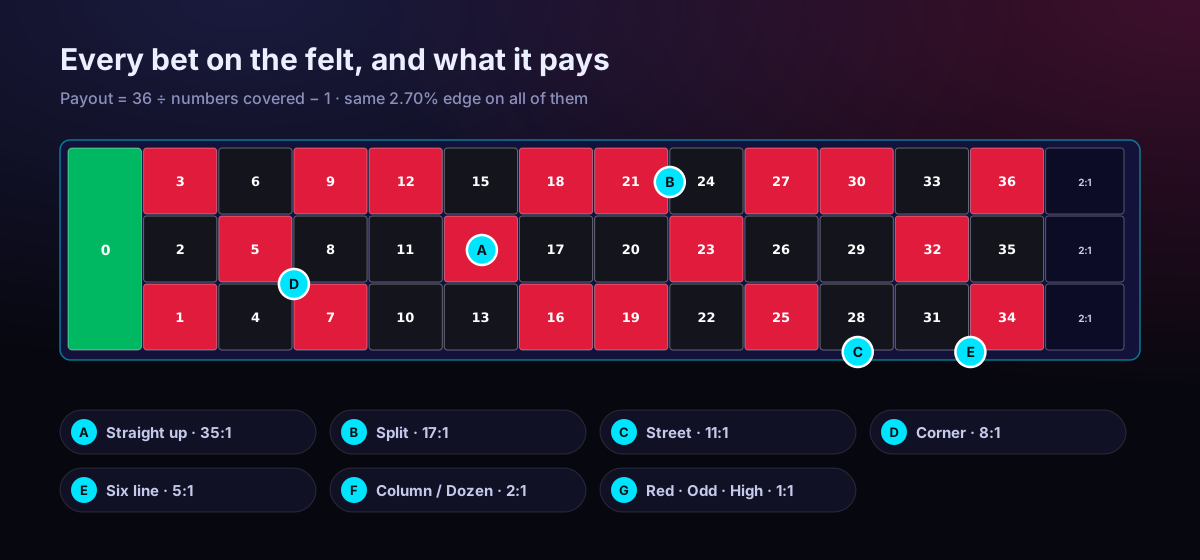
Inside bets sit on the numbered grid and cover between one and six pockets. They pay more and hit less often. On a single-zero wheel, all of them cost 2.70% of what you stake.
| Bet | How to place it | Covers | Pays | Chance (European) |
|---|---|---|---|---|
| Straight up | Chip in the centre of one number | 1 | 35:1 | 2.70% |
| Split | On the line between two adjacent numbers | 2 | 17:1 | 5.41% |
| Street | On the outer edge of a row of three | 3 | 11:1 | 8.11% |
| Corner (quad) | On the intersection of four numbers | 4 | 8:1 | 10.81% |
| Six line | On the outer edge between two rows | 6 | 5:1 | 16.22% |
| Trio | On the corner joining zero to two numbers | 3 | 11:1 | 8.11% |
| Five number | American only — the 0/00/1/2/3 corner | 5 | 6:1 | 13.16% |
The five-number bet is the one bet to avoid outright. It exists only on American wheels and pays 6 to 1 against true odds of 6.6 to 1, for a house edge of 7.89% — worse than every other bet on the same table. Every other American bet costs 5.26%.
Outside bets
Outside bets sit around the grid and cover twelve or eighteen pockets. They hit far more often and pay far less. Same 2.70% on a single-zero wheel.
| Bet | Covers | Pays | Chance (European) | Chance (American) |
|---|---|---|---|---|
| Dozen | 1–12, 13–24 or 25–36 | 2:1 | 32.43% | 31.58% |
| Column | One of the three rows of twelve | 2:1 | 32.43% | 31.58% |
| Red / Black | All eighteen of one colour | 1:1 | 48.65% | 47.37% |
| Odd / Even | All eighteen odd or even numbers | 1:1 | 48.65% | 47.37% |
| High / Low | 19–36 or 1–18 | 1:1 | 48.65% | 47.37% |
Note that zero is neither red nor black, neither odd nor even, and neither high nor low. It belongs to no outside bet, which is exactly how the house edge is collected on them.
Call bets and the racetrack
French and many European tables add an oval betting area laid out in wheel order rather than numeric order. It lets you bet on a physical region of the wheel in one action, using a fixed number of chips.
| Call bet | Chips | Pockets | Numbers covered |
|---|---|---|---|
| Voisins du Zéro | 9 | 17 | 22, 18, 29, 7, 28, 12, 35, 3, 26, 0, 32, 15, 19, 4, 21, 2, 25 |
| Tiers du Cylindre | 6 | 12 | 27, 13, 36, 11, 30, 8, 23, 10, 5, 24, 16, 33 |
| Orphelins | 5 | 8 | 17, 34, 6, 1, 20, 14, 31, 9 |
| Jeu Zéro | 4 | 7 | 12, 35, 3, 26, 0, 32, 15 |
You will also hear "neighbours" — a bet on a chosen number plus the two pockets either side of it on the wheel, five chips in total. Call bets are combinations of ordinary splits and straight-ups, so they carry the same edge. They are convenience, not advantage. Try them in the French roulette demo.
The four rules that change the maths
La partage
When zero lands, even-money bets lose only half. Expected return on red becomes (18 × 2 + 0.5) ÷ 37 = 98.65%, so the house edge halves to 1.35%. This is the single most valuable rule in roulette and it costs nothing to use — you simply need a table that offers it.
En prison
Instead of returning half immediately, the table locks your even-money stake for one further spin. Win it and you get the stake back with no profit; lose and it is gone. Over the long run this produces the same 1.35% edge as la partage.
Surrender
The American equivalent of la partage, returning half of even-money stakes on 0 or 00. It brings those bets from 5.26% to 2.63%. Rare — assume it is not offered unless the table explicitly says so.
Table minimum and maximum
Not a payout rule, but it decides whether progression systems are even possible. A $10 minimum with a $500 maximum kills a Martingale after six consecutive losses, which happens roughly once in 55 sequences on an even-money bet. Our strategy simulator lets you set the ceiling and watch the ruin rate respond.
At a real table
- Buy chips at the table, not the cashier. Roulette uses table-specific colour chips so the dealer can tell whose bets are whose. They are worthless at other tables — cash them in before you leave.
- Do not touch chips after "no more bets". Reaching over the layout once the ball has slowed is the one thing that will genuinely annoy a dealer.
- Announce call bets clearly. "Voisins, one chip" is a verbal contract. The dealer will place it and you owe it.
- The scoreboard is decoration. Displays of recent numbers exist to suggest patterns. Each spin is independent; a run of eight reds tells you nothing about the ninth.
- Check the wheel before you sit. One zero or two? That decision is worth more than everything else you do at the table.
Online, live and RNG roulette: what changes
The rules above are identical wherever you play, but the format changes the experience — and, through pace, the cost.
| Format | How it works | Typical spins/hour | What to watch |
|---|---|---|---|
| Land-based table | Physical wheel, human dealer, chips on felt | 30–40 | Table minimums; American wheels in the US |
| Live dealer (online) | Studio wheel streamed to your screen, bets placed digitally | 50–90 | Betting closes before you see the spin |
| RNG roulette | Animated wheel driven by a random number generator | 200–600 | Pace — auto-play multiplies the hourly cost |
| Free demo (this site) | RNG with virtual credit | Any | Nothing at stake — results predict nothing |
Same odds in every row. The difference is how many times per hour those odds are applied: an RNG table on auto-play can run fifteen times faster than a busy casino table, and the expected cost per hour scales with it. Put your own pace into the session cost calculator to see what that means for you.
Your first session, step by step
- Open the European demo and place one of each bet type, watching the house-edge readout stay at 2.70%.
- Switch to French and place red: the even-money edge drops to 1.35% — that is la partage.
- Try a call bet from the racetrack and compare the pockets it covers with the wheel layout guide.
- Spin fifty times on the wheel simulator to see what streaks look like.
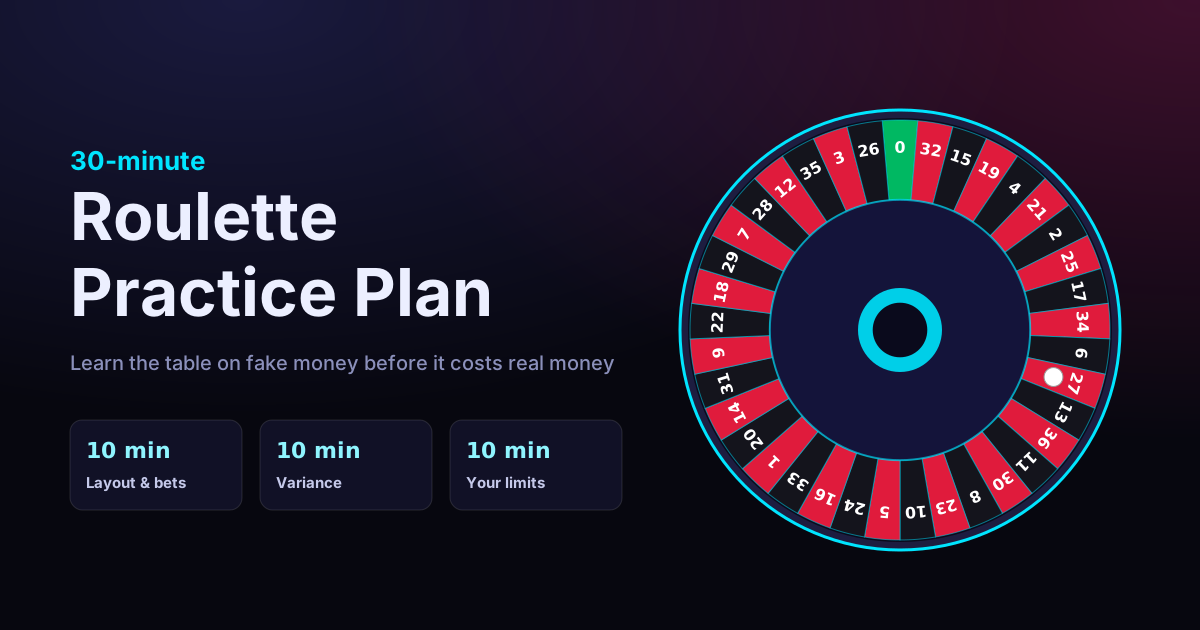
- Read the 30-minute practice plan for the full version.
Roulette rules FAQ
Is zero red or black?
Neither — zero is green, and it belongs to no outside bet. It is not odd, not even, not high and not low. That exclusion is precisely how the house edge is collected on even-money bets.
What happens to my bet when zero lands?
On a standard European or American table, all outside bets lose in full. On a French table with la partage, even-money bets lose only half. Inside bets on zero itself are paid normally.
Can I bet on both red and black?
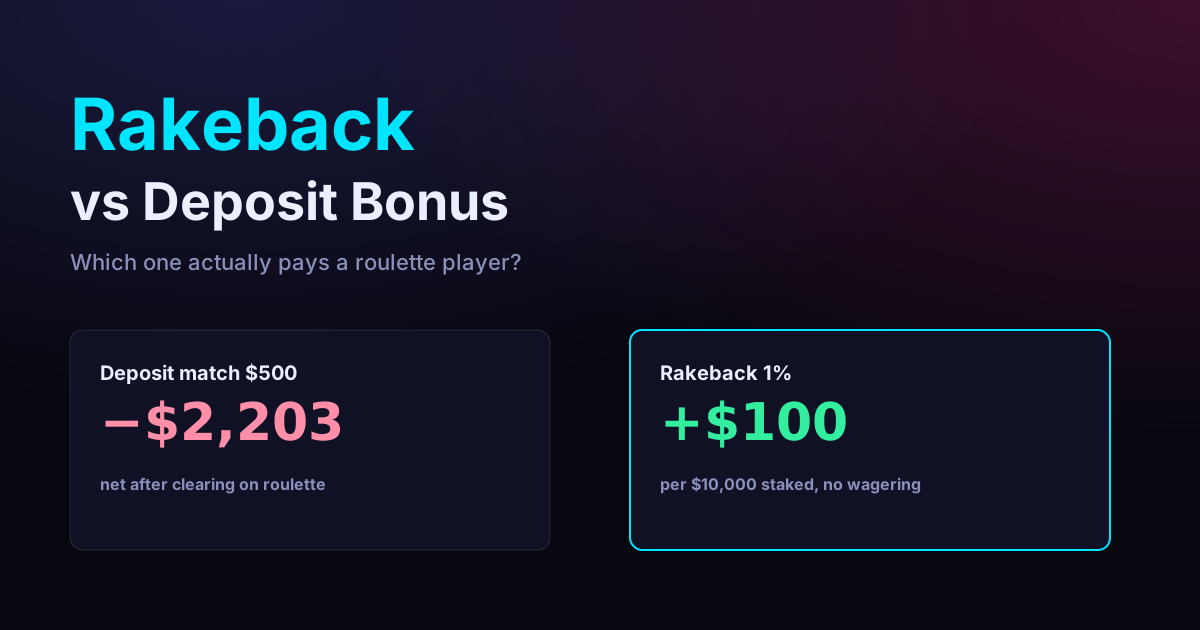
You can, and it is pointless. The two bets cancel out on every number except zero, where both lose. You would be staking money purely to lose 2.70% of it more slowly. Many bonus terms also void offers for exactly this pattern.
What is the minimum number of chips for a call bet?
Voisins du zéro needs nine, tiers du cylindre six, orphelins five and jeu zéro four. Each covers different pockets with a fixed pattern of splits and straight-ups, so the chip count is not negotiable.
Do dealers influence where the ball lands?
On a well-maintained modern wheel, no — the ball bounces far too chaotically for a release to be repeatable. Historical dealer-signature advantage play required a worn wheel, a consistent dealer and thousands of logged spins, and it is not viable against modern equipment or any RNG game.
Go deeper
Long-form pieces built on our simulators and calculators — more on the roulette blog.

GETRAKEBACK. 18+.
Other guides
- Roulette Odds & Payouts — The full payout and probability table for every wheel, side by side.
- Roulette Strategies — Ten systems, what each actually does to your distribution, and why none change the edge.
- Roulette Wheel Layout — Pocket order, wheel sectors, the racetrack and why the numbers sit where they do.
- European vs American Roulette — One extra pocket, double the cost. The comparison in full.
- Roulette House Edge — Where the edge comes from, how it is calculated, and what it costs per hour.
18+. Roulette has a fixed house edge, so over enough spins the maths favours the operator — always. If you play for real, treat it as money spent on entertainment, set a limit before you start and stop when you reach it. Our responsible gambling page covers the warning signs and where to get free, confidential help.